Published: 24 March 2026
This month, RM Sotheby's presents The Outlaw Collection — a live auction dedicated to the personal cars of Magnus Walker, a British-born designer and customiser based in Los Angeles, widely known as the "Urban Outlaw." The sale spans 162 lots and covers nearly five decades of Porsche production, tracing the evolution of the brand through the eyes of one of its most recognisable modern enthusiasts.
The collection ranges from early short-wheelbase 911s to wide-bodied Turbos and the often-overlooked front-engined Porsches of the 1980s and 1990s, reflecting both the breadth of Walker's taste and the depth of his passion for the brand. The second release of lots has now concluded, with the final drop having taken place on 3 March 2026.
Walker began collecting Porsches in 1992. Over the years, he built not only an impressive collection — including 911s, 914s, 928s and 944s — but also a very distinctive personal style. His "outlaw" approach blends 1970s motorsport influences with purposeful, road-driven performance. Louvred engine lids, lightweight components and cars that proudly show their age are recurring themes throughout his work. Having founded Serious Clothing, his background in fashion strongly shapes his aesthetic, and his international profile grew significantly after the 2012 documentary Urban Outlaw. Below, we present three carefully chosen cars that capture different eras of Porsche history through Walker's legendary collection.
1976 Porsche 911 Carrera 2.7 MFI
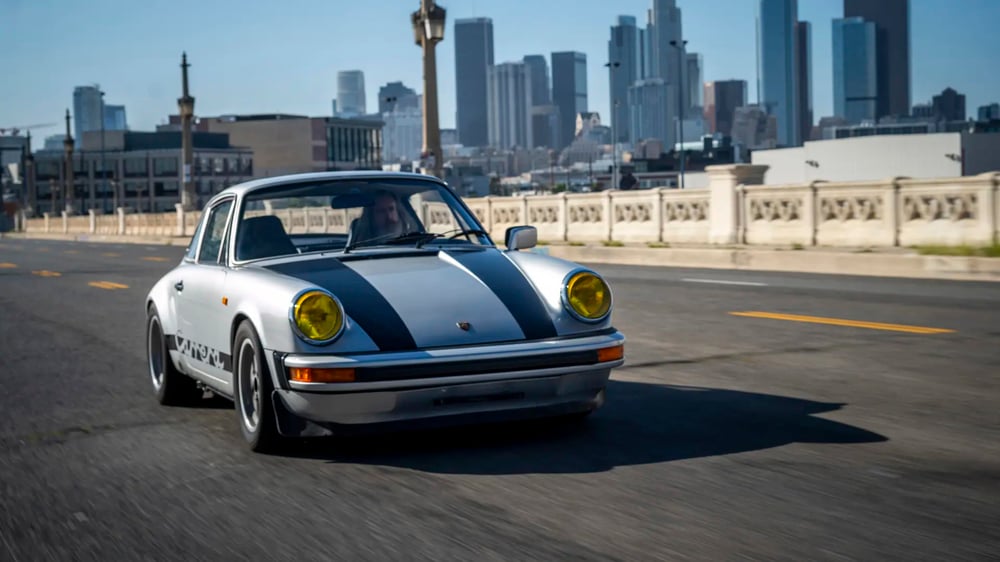
At first glance, this 1976 911 looks like a fairly standard example of its generation. In reality, it is one of the rarest production variants of its time. The Carrera 2.7 MFI is powered by the Type 911/83 engine — the same 210-horsepower flat-six found in the celebrated 1973 Carrera RS 2.7, using Bosch mechanical fuel injection. This system delivers sharper throttle response and a more characterful engine note than the later fuel systems that replaced it.
Between 1974 and 1976, Porsche built 1,633 Carrera 2.7 MFI coupes in total. For 1976 alone — as the model was being phased out in favour of a larger 3.0-litre engine — just 113 final examples were assembled. All were built without a sunroof, all carried the RS-specification engine, and all were reportedly intended for the German market as special homologation models for a racing series that never actually took place. These cars marked the end of mechanical fuel injection in road-legal 911s; after 1976, this technology was reserved exclusively for full competition cars.
Walker acquired this example in 2009 after identifying its unusual chassis number — which included a designation linked to homologation models — and confirming its rarity through research. It is believed to be the 23rd of the 113 special examples produced. According to its Porsche Certificate of Authenticity, it left the factory finished in Silver Metallic over black leatherette, with a radio antenna, front speakers and noise suppression as listed options.
Walker has added personal touches — tartan velour bucket seats, a ducktail spoiler, Carrera side graphics and a two-tone bonnet treatment — but the car retains its original, numbers-matching engine. Beneath its understated exterior lies one of the last road-going examples of Porsche's race-derived mechanical fuel injection heritage.
1976 Porsche 911 Turbo
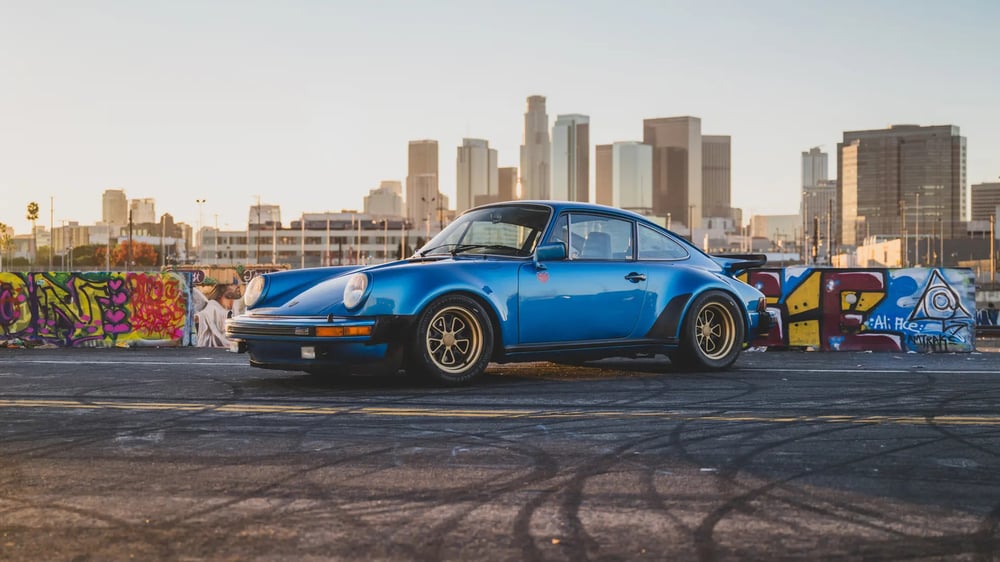
The European-market 3.0-litre 930 Turbo holds a special place among early turbocharged 911s. Producing 260 horsepower — compared to 240 horsepower in US-specification cars — it benefits from a different camshaft profile while sharing the same 3.0-litre engine and four-speed gearbox. The result is a slightly more responsive and engaging driving character.
This particular car is a Swiss-delivery, sunroof-delete example finished in Minerva Blue Metallic. As a European-specification model, it features smaller bumper overriders than its American counterpart, giving it a cleaner visual appearance and marginally more headroom inside. Originally delivered with a full white leather interior, it now features blue leather and corduroy seats taken from another car in Walker's collection, creating a distinctive and intentional contrast in textures.
Walker acquired the car in 2013, and it reflects his outlaw philosophy clearly. It rides on deep-dish wheels developed in collaboration with Fifteen52 — the very first set produced as part of his Outlaw Wheel project. The tyre setup is staggered, with wider rubber at the rear, and the lowered ride height gives the car the aggressive stance of a racing Porsche 934.
A semi-custom exhaust system adds a sharper, more pronounced soundtrack, amplifying the sound of the turbocharger spooling and the crackle on overrun. The engine remains numbers-matching, as confirmed by renowned Porsche expert Jürgen Barth. Repainted in a close variation of its original Minerva Blue, with gold-bronze and black wheel centres, the car strikes a careful balance between collectability and strong individual character.
As an early Euro-specification 930 Turbo, it is already a highly desirable car. In Walker's hands, it became something more — sitting at the intersection of performance and personal style.
1966 Porsche 911
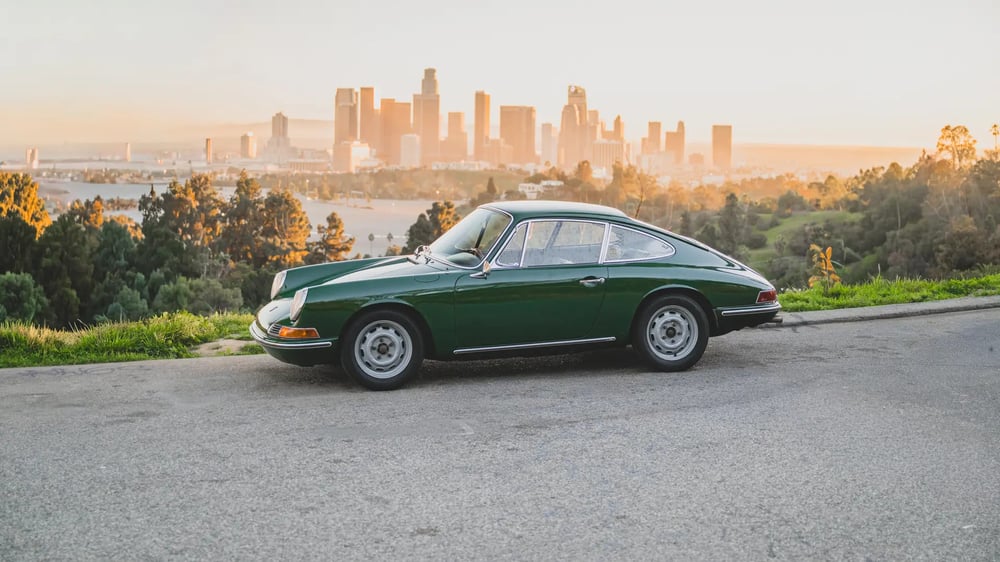
Completed in January 1966 and delivered that spring through a Porsche dealership in Burlingame, California, this Irish Green 911 is one of the earliest short-wheelbase examples in Walker's collection. Its factory records list "B. Wilson" as the original owner, though no further details are known.
Walker acquired the car in 2009 following a brief trip to Seattle to inspect it in person. It retains its numbers-matching flat-six engine and wears a repaint in its correct factory Irish Green over black leatherette. The original interior, carpets and wood-rimmed steering wheel all display genuine, well-preserved character that comes only with age.
After purchasing the car, Walker replaced later-style Fuchs alloy wheels with simple grey-coated steel wheels, run without hubcaps — giving the car a purposeful, no-frills stance. On narrow period-correct tyres, the driving experience is tactile and rewarding, characterised by body roll and direct feedback that reflect the 911's earliest personality.
Unlike many of Walker's more heavily modified cars, this example remains largely as he found it. It has appeared at select automotive gatherings and featured in a 2013 video, but has otherwise remained a long-standing fixture in his garage. In his own words, it was never "improved" or "butchered" — retaining exactly the character and patina that first drew him to it.