Published: 3 January 2025
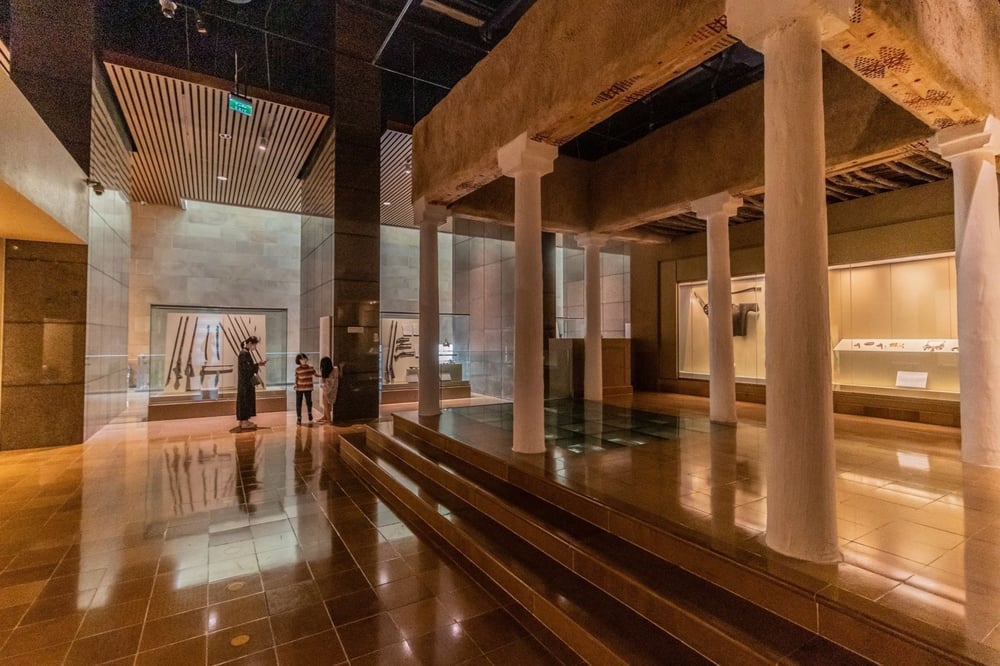
The Saudi National Museum stands as one of the Kingdom’s premier cultural landmarks, embodying the rich history of the Arabian Peninsula and its evolution across the ages. Officially opened in 1999 as part of the King Abdulaziz Historical Centre project, it is situated in the Al-Murabba district at the heart of Riyadh. Covering an expansive area of approximately 17,000 square metres, the museum houses a diverse collection of archaeological artefacts and cultural exhibits, tracing the region’s development from ancient times through to the unification of Saudi Arabia under King Abdulaziz.
More than a repository of artefacts, the National Museum serves as a cultural and educational centre, enhancing visitors’ understanding of the Arabian Peninsula’s natural, human, cultural, and religious history. Its modern display style follows a carefully planned chronological flow, guiding visitors seamlessly through the different eras while highlighting the key events and achievements that shaped the region’s civilisation.
Origins of the Saudi National Museum
The concept of the Saudi National Museum emerged in the early 1980s, but the implementation of the project started within the 1995 plan to redevelop the historic Al-Murabba district. Known as the “Al-Murabba Development Plan,” this initiative aimed to revive the area surrounding the historic Al-Murabba Palace, transforming it into a cultural and knowledge hub that reflects Saudi history.
Canadian architect Raymond Moriyama was commissioned to design the museum, drawing inspiration from the Kingdom’s desert landscape — particularly the shape of the red sand dunes surrounding Riyadh. The western façade evokes the fluidity of shifting sands, while the exterior lines form a crescent pointing to Mecca. The museum’s layout connects to a spacious reception hall leading to a central courtyard, dividing the museum into two main wings:
- The Northern Wing: Dedicated to pre-Islamic history.
- The Southern Wing: Focused on Islamic history and its subsequent periods.
Two additional halls are reserved for hosting temporary exhibitions and cultural events, reinforcing the museum’s role as a dynamic hub that keeps pace with evolving cultural activities.
Also Read: Historic Homes in Saudi Arabia
Cultural and Educational Identity
The Saudi National Museum adopts a contemporary educational vision, moving beyond the traditional museum model that centres solely on historically valuable artefacts. It offers an immersive, interactive experience, presenting historical concepts in ways that engage visitors of all ages. Replicas of key objects, crafted to match the originals in scale and form, allow visitors to appreciate historical contexts more fully.
Modern display technologies — interactive screens, scale models, and audiovisual effects — further enrich the visitor experience, making learning both enjoyable and smooth. The museum’s collection includes approximately 3,700 artefacts, alongside 900 visual aids, 45 films, and numerous sound effects, rendering it a rich collection of historical and cultural knowledge.
Also Read: Traditional Markets in Saudi Arabia
Mission of the Saudi National Museum
The museum’s mission is to provide a comprehensive cultural and educational experience that reflects the Kingdom’s identity and illustrious history. Its principal objectives include:
- Serving as a distinguished national landmark representing Saudi Arabia both locally and internationally.
- Enriching cultural and historical awareness within the community and fostering national pride through the celebration of Arabian heritage.
- Offering an interactive learning environment for all visitors, including children, families, researchers, and specialists.
- Preserving and displaying heritage artefacts in ways that maintain their historical significance.
- Strengthening the museum’s cultural role through temporary exhibitions and educational events that advance knowledge and awareness.
Also Read: Traditional Crafts of Saudi Arabia
Future Aspirations
The Saudi National Museum aspires to be a leading centre for archaeology and museology in the Kingdom, with goals such as:
- Systematically and scientifically documenting and preserving both ancient and newly discovered artefacts.
- Hosting educational exhibitions highlighting the Arabian Peninsula’s history from multiple perspectives.
- Supporting and developing educational programmes focusing on history, culture, and natural and technical sciences.
- Attracting visitors with interactive exhibits that cater to all age groups.
Also Read: Vision 2030 the Saudi Arabia of Tomorrow
Exhibition Halls
The museum’s exhibition halls are among the most important attractions, carefully organised to chronicle the successive historical periods of the Arabian Peninsula. The museum features eight principal halls:
- Hall of Man and the Universe: Explores the origin of the universe and the geology of the Arabian Peninsula, featuring meteorites from the Empty Quarter and interactive models of the solar system and plant life evolution.
- Hall of Arabian Kingdoms: Highlights ancient kingdoms such as Dilmun and Midian, along with cities like Dumat Al-Jandal and Al-Hamra, as well as later Arabian kingdoms in Al-Aflaj and Najran.
- Pre-Islamic Era Hall: Focuses on the pre-Islamic period, including notable cities such as Mecca and Jerash and trading markets like Okaz and Mijaz, along with the development of writing and Arabic script.
- Prophetic Mission Hall: Highlights the life of the Prophet Muhammad (PBUH) through detailed biographical displays and genealogical charts.
- Islam and the Arabian Peninsula Hall: Covers the emergence and expansion of Islam in Medina and the history of the Islamic Caliphate across the Peninsula.
- First and Second Saudi State Hall: Explores the history and cultural and political evolution of the First and Second Saudi States.
- Unification of the Kingdom Hall: Showcases King Abdulaziz Al Saud’s efforts in unifying the Kingdom and establishing the modern state.
- Hajj and the Holy Sites Hall: Features a large-scale model of Mecca and its surroundings, reflecting the importance of Hajj in Muslim life.
Also Read: Beaches of Saudi Arabia
A Centre for Knowledge and Community
The Saudi National Museum extends beyond its role as a display venue, functioning as an educational and knowledge centre that serves society. Through its programmes and activities, it nurtures national identity and cultural values for younger generations while providing researchers with the resources to delve into the Kingdom’s history and heritage.
Ultimately, the Saudi National Museum embodies the Kingdom’s rich legacy, offering a window into the past and connecting present generations with their extraordinary history.
-jpg.jpeg)
-jpg.jpeg)