Published: 19 January 2026
Marking a new chapter in Sotheby’s long-term commitment to the Gulf, the auction house returns to Riyadh for the second edition of its Origins II event, culminating in a live auction on 31 January. The sale signals both continuity and momentum, reaffirming Sotheby’s belief in the region’s cultural landscape and international relevance.
Building on the success of the inaugural Origins auction held in Saudi Arabia in February 2025, Origins II resumes that narrative with the same purpose. The first sale proved a defining moment, showing strong regional appetite for museum-quality works and confirming Riyadh’s position as a well-established centre for serious collecting. This second iteration deepens Sotheby’s engagement and its role as a platform through which significant artworks are brought into global conversation. Offering international visibility and supporting local artistic infrastructure, the auction house continues to contribute meaningfully to the Kingdom’s expanding art ecosystem.
Defining Cultural Season
Origins II pulls together a carefully curated selection of works whose cultural and historical weight often sees them exceed expectations at auction. These are pieces that resonate beyond the sale room, showing the depth and ambition of the region’s collecting community and its growing influence on the global art market.
The timing of the auction is deliberately aligned with a wider cultural moment. Origins II coincides with the opening of the Diriyah Contemporary Art Biennale and sits alongside the inaugural Art Basel Doha, which makes its Middle Eastern debut in February. Together, these events signal a new rhythm for the region’s cultural calendar. Ahead of the live sale, all works from Origins II will be presented in a public exhibition at Diriyah’s Bujairi Terrace from 24 to 31 January, offering visitors a week-long opportunity to engage with the artworks in an open, celebratory setting.
Returning to Riyadh
When a symbolic event requires a symbolic setting, Diriyah more than fits the occasion.
Diriyah is the birthplace of the Kingdom of Saudi Arabia and a site of profound historical resonance. It makes sense that an event such as Origins II would unfold in a location that carries both symbolic and cultural weight. Home to the At-Turaif UNESCO World Heritage Site, Diriyah is a symbol of the Kingdom’s foundations, making it a perfect host for an auction that bridges past, present and future.
This year’s sale brings together a considered selection of works drawn from Sotheby’s global network, with a curation that spans geographies, periods and disciplines. The ensemble reflects the sophisticated appetite of the Saudi art market and its growing engagement with the international scene. Middle Eastern artists sit alongside leading global figures, creating a narrative that celebrates regional creativity within a broader art context.
The breadth of works on offer are expected to command strong competition across categories. Highlights include key pieces by some of Saudi Arabia’s most important artists of the past century, shown alongside big names such as Pablo Picasso. In total, more than 70 lots form an impressive display of Modern and Contemporary Art, complemented by objects from Ancient Sculpture, 20th-century Design, Prints, and works representing Latin American and South Asian traditions.
Headline Lots
Safeya Binzagr: Coffee Shop in Madina Road (1968, oil on board, estimate. $150,000-200,000)
Among the defining works at Origins II is Coffee Shop on Madina Road by Safeya Binzagr, one of Saudi Arabia’s most important artistic voices. Painted in 1968, the work reflects Binzagr’s lifelong commitment to documenting the customs, rituals and everyday pulse of her country at a moment of rapid change. Speaking of her early exhibitions, she once observed that audiences responded most deeply to scenes rooted in desert life and daily Saudi experience, prompting her to dedicate her art to recording traditions she feared might disappear.
Born in Jeddah, Binzagr travelled extensively across the Kingdom, sketchbook in hand, capturing dress, social gatherings and domestic interiors with care and commitment. Her work is both documentary and deeply personal, offering an insider’s view of a society rarely represented on its own terms. In recognition of her cultural legacy, she was awarded the King Salman bin Abdulaziz Medal in 2017 for her role in preserving Saudi identity through art.
Mahmoud Sabri: Demonstration (1968 oil on canvas, estimate. $400,000-500,000)
Demonstration is a powerful example of Mahmoud Sabri’s emotionally charged visual language. A leading figure in modern Iraqi art and former head of the country’s first government-run art exhibitions department, Sabri used painting as a tool for social commentary. This rare work details a group of female mourners, combining elements of Christian iconography with social realism to convey collective grief and resistance.
Themes of martyrdom, loss and endurance recur throughout Sabri’s works, reflecting the political and human cost of war-torn Iraq. In Demonstration, the figures are rendered with solemn dignity, transforming a moment of protest into a universal image of sorrow and resolve.
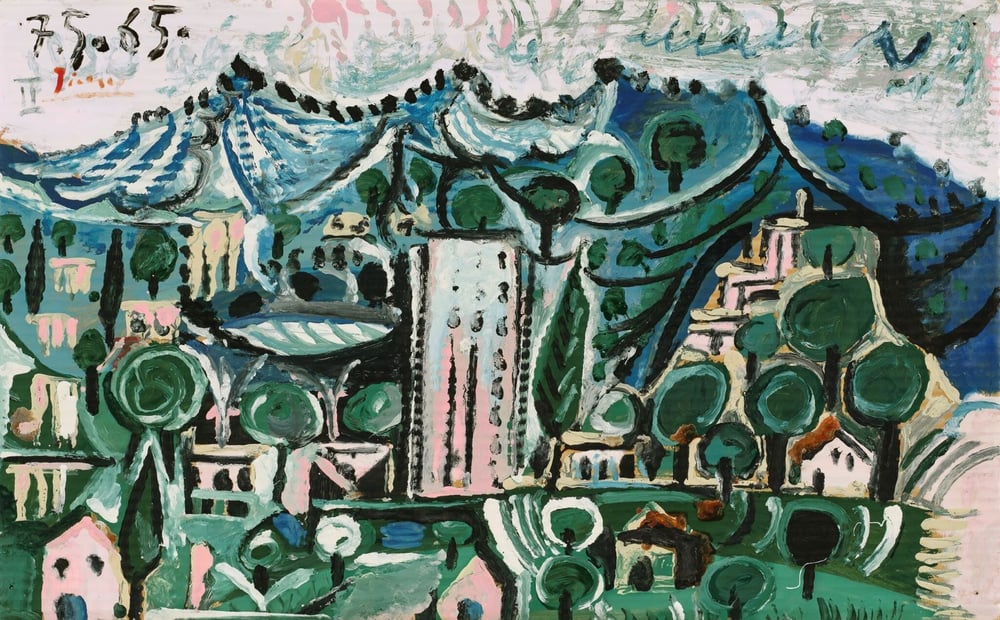
Pablo Picasso: Paysage (1965, oil and Ripolin on cardboard, estimate. $2,000,000-3,000,000)
The undisputed centrepiece of the sale is Picasso’s Paysage, one of the most compelling works from his late engagement with landscape. Painted in 1965, the composition draws on the terrain surrounding Mougins, where Picasso spent his final years. Here, landscape is not observed from a distance but absorbed into the artist’s inner world. Unlike the sombre, restrained palettes of his wartime Paris landscapes, Picasso’s works of the 1950s and 1960s embrace colour with confidence. In Paysage, bold, saturated tones transform the Massif de l’Esterel into a psychological terrain, where memory, emotion and place converge. It is a work that speaks less of topography than of identity, capturing a moment in which the external world becomes inseparable from the artist himself.
Final Thought
Riyadh reveals a city of many layers. Great destinations in Riyadh, like Diriyah, don’t negotiate art and culture over luxury – they harmonise them. It was Diriyah’s cultural authenticity that sat at the heart of Sotheby’s placemaking and the company did well when deciding to undertake the mandate of official incorporation in Saudi Arabia at the end of 2025. The first-ever auction by Sotheby’s in Diriyah generated $17.3 million, with around a third of the buyers hailing from the Kingdom. It also signalled a new era for the 280-year-old auction house as it launched its newest premises in the thriving city of Riyadh. Sotheby’s decision to establish a permanent presence will be transformative for the region and entirely in synergy with the government’s programme Vision 2030, which places cultural growth and social diversity at its core. Through exhibitions, experiences, and dialogue, Sotheby’s will contribute to a broader cultural conversation, bringing the auction house’s values and expertise into one of the Kingdom’s most culturally significant settings.